9 Tools That Made Our Move Easier (and We Still Use Today)
The kit we wished someone had told us about before moving day
When we moved into our first home, we had a screwdriver and an optimistic attitude. Within a week we'd made three trips to the hardware shop. Most of what we bought turned out to be the wrong thing, the wrong size, or unnecessary. After settling in, we worked out which tools we actually reached for again and again - and which ones made the move itself far less stressful. Here are the nine that made the biggest difference for us.
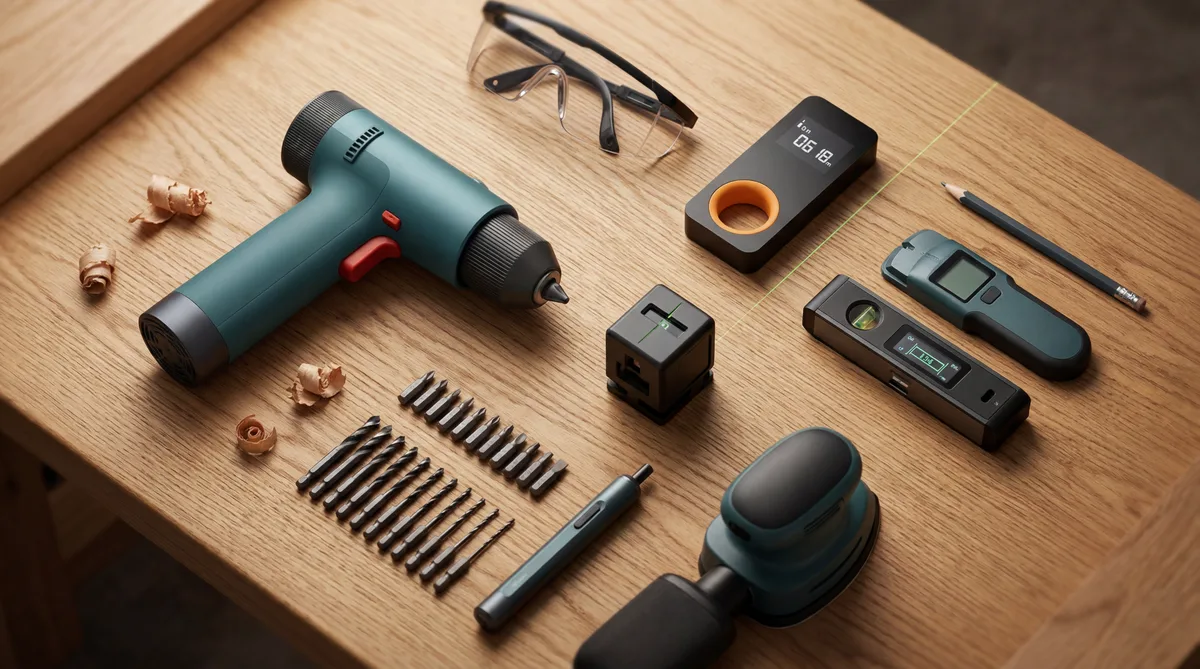
Laser distance measurer
This was the single most useful tool during the buying process. Before we'd even moved in, we were measuring rooms at viewings to check whether our furniture would fit. Standing in an empty room trying to gauge whether a 2.4m sofa fits into a 2.7m alcove is impossible by eye alone.
The HOTO Laser Measuring Tape is genuinely pocket-sized - smaller than a credit card holder and light enough to forget it's there. It's rechargeable via USB-C, accurate to within a couple of millimetres, and calculates area and volume automatically. You point it at a wall, press a button, and the distance appears on the OLED screen. It's the kind of tool that feels like it should cost more than it does.
We used ours at every viewing, on moving day (positioning furniture before the removal team brought it in), and still use it regularly for shelving, curtain rails and picture hanging. It lives in a coat pocket now.
- Useful at viewings - measure rooms on the spot and compare against your furniture
- Note ceiling heights in older properties - they vary more than you'd expect
- Calculate room area instantly to estimate flooring and paint quantities
- USB-C rechargeable - no hunting for obscure batteries
Cordless drill
A cordless drill is the tool you'll use more than any other in your new home. Curtain poles, shelving brackets, TV mounts, baby gates, coat hooks - nearly every home improvement starts with drilling a hole.
The Xiaomi Brushless Cordless Drill is a solid option: lightweight, brushless motor (longer-lasting and more efficient), good battery life, and powerful enough for most domestic jobs without being unwieldy. It comes with adjustable torque settings, which matter more than you'd think - too much torque and you'll strip screw heads or crack plaster.
If you're choosing between a budget and mid-range drill, spend a little more. Cheap drills overheat quickly, have poor battery life, and the chucks wobble - meaning your holes won't be straight.
- A separate set of masonry and wood bits is a good idea - the ones that come in the box are usually poor quality
- Having the battery charged and a spare to hand on moving day saves time
- Starting on the lowest torque setting and increasing gradually prevents damage to screw heads
Electric screwdriver
Different from a drill. An electric screwdriver is lighter, smaller, and designed specifically for driving screws - not drilling holes. If you've ever assembled flat-pack furniture by hand, you'll know the unique misery of tightening 47 cam lock screws with a manual Allen key.
The Xiaomi Electric Precision Screwdriver (or the Xiaomi Mi Power Screwdriver) comes with interchangeable bits and an adjustable torque that prevents overtightening. We assembled an entire IKEA wardrobe, two bedside tables and a desk in an afternoon. By hand, that would have taken most of a weekend and several paracetamol.
It's also useful for smaller jobs around the house: tightening loose handles, swapping plug sockets (with the power off), or opening battery compartments on children's toys.
- Saves hours on flat-pack assembly compared to the included Allen key
- Most people end up keeping it in a drawer rather than the toolbox - it gets used constantly
- The precision bits work for electronics and small household items too
Stud finder
Walls in newer-build homes are frequently plasterboard over timber studs. If you drill into plasterboard alone and try to hang anything heavier than a picture frame, it will pull straight out. A stud finder tells you where the solid timber is behind the plasterboard, so you can fix into something that will actually hold.
You slide it slowly along the wall and it beeps or lights up when it detects a stud. Better models also detect live wiring and metal pipes, which is important - drilling into a water pipe or electrical cable on day two of your move is a scenario worth avoiding.
If your home has solid brick walls (common in pre-1960s properties), you won't need this as often, but it's still useful for finding pipes and cables before drilling.
- Scanning for cables and pipes before drilling - even into brick - avoids costly accidents
- Studs are typically 400mm or 600mm apart - once you find one, the next is predictable
- Heavy items such as TV mounts are typically fixed into studs rather than plasterboard anchors alone.
Digital spirit level
A spirit level is essential for hanging anything straight - shelves, pictures, mirrors, curtain poles. A digital one gives you a precise angle readout rather than relying on squinting at a tiny bubble.
The digital readout makes it much faster. Hold it against the wall, read the number, adjust. No second-guessing whether the bubble is really centred or just close enough. Most digital levels also have a magnetic base, which is useful for checking metal surfaces are true.
We hung every shelf and picture rail in our house using one, and it took a fraction of the time it would have with a traditional level. It's one of those tools that seems unnecessary until you use it.
- Even small picture frames look noticeably crooked without a level
- Worktops and appliances are worth checking with a level when the kitchen is installed
- A longer level (at least 600mm) is more accurate for shelving and rails
Laser level
A spirit level tells you if something is straight. A laser level projects a perfectly straight line across the wall so you can work hands-free. For hanging a TV bracket, a row of pictures, a curtain pole, or a shelf - you set it up, switch it on, and it gives you a visible reference line to work to.
The difference is practical: with a spirit level, you need to hold the level, mark the wall with a pencil, then move the level, then drill. With a laser level, you stick it to the wall or set it on a surface, and the line stays there while you drill, measure and adjust. It's especially useful for longer runs - like a picture rail or a row of hooks - where a short spirit level would need repositioning multiple times.
We use ours every time we hang anything. Once you've used a laser line to position a TV mount, going back to pencil marks and a spirit level feels slow.
- Particularly useful for TV mounting - projects a level line across the full wall width
- Self-levelling models adjust automatically on slightly uneven surfaces
- Useful for tiling, dado rails, and aligning a row of pictures or frames
- A spirit level checks if something is level - a laser level shows you where level is
Sander
If you're planning any decorating - and most people do within the first few months - a sander will save you enormous effort. Sanding by hand is tedious and inconsistent. An electric sander does in ten minutes what takes an hour by hand, and produces a far more even finish.
A detail sander (triangular pad) is the most versatile for domestic use. It gets into corners, works on skirting boards and window frames, and is small enough to use one-handed. For larger surfaces like doors or floorboards, a random orbital sander is faster.
We used ours to prep every door frame, skirting board and windowsill before painting. The difference between sanded and unsanded surfaces is immediately visible once the paint goes on.
- Start with a coarser grit (80) to remove old paint or varnish, then finish with fine (120-180)
- Paint adhesion is dramatically better on a sanded (keyed) surface
- A dust mask is important when sanding old paintwork, which can release harmful particles
Safety goggles
This is the least exciting item on the list and the one you'll be most grateful for. Drilling into masonry sends small chips of brick, plaster and dust directly towards your face. Sanding produces fine dust that irritates eyes for hours. Using a saw of any kind without eye protection is a risk not worth taking.
A decent pair of safety goggles costs very little and fits over glasses if needed. We keep ours in the toolbox and put them on before any drilling, sanding or cutting. It takes two seconds and it only takes one incident to understand why.
If you're doing any demolition work - even just removing old tiles or pulling up floorboards - goggles are essential, not optional.
- Anti-fog goggles are worth the small premium - standard ones steam up quickly
- Keeping them with the drill makes them easy to grab
- Over-glasses goggles fit over prescription glasses
How much will all this cost?
You don't need to spend a fortune. The Xiaomi drill and screwdriver offer excellent performance at a fraction of the price of premium brands, and the HOTO laser measurer was good value for us. Together, those three cost well under what you'd pay for a single premium brand drill alone.
As a rough guide, the items on this list can typically be bought for around £200-250 in total. That's a fraction of what you'll save by doing basic jobs yourself rather than calling someone in. Hanging curtain poles alone would cost £40-80 per window if you hired a handyman.
The HOTO laser measurer is useful from viewings onwards, the Xiaomi drill and screwdriver are handy from moving day, and the laser level, stud finder, sander, spirit level and goggles can be picked up once you're settled in.
Key takeaways
- 1The HOTO laser measurer is useful from viewings onwards - pocket-sized and measures rooms instantly
- 2The Xiaomi cordless drill and electric screwdriver are the two tools you'll use most in the first month
- 3A stud finder prevents costly mistakes when fixing to plasterboard walls
- 4A laser level makes hanging TVs, pictures and shelves far easier than a spirit level alone
- 5Safety goggles cost almost nothing - wear them every time you drill or sand
- 6The items on this list can typically be bought for around £200-250 in total
General information only. This article is for educational purposes and does not constitute legal, financial, surveying or tax advice. Every property purchase is different - always consult a qualified solicitor, mortgage adviser or surveyor before making decisions. Home Ready Guide Limited is not FCA authorised.
Related articles
What to Actually Look For on a Property Viewing
When we started viewing houses, we spent half the time admiring the décor. It took a few viewings (and some honest feedback from our surveyor) to realise that paint colours and garden tidiness have nothing to do with whether a house suits your needs. Here's what to actually look at - and what you may want to look at more carefully.
Read article
7 Mistakes First-Time Buyers Make (and How to Avoid Them)
Buying your first home is exciting, and it's also the point at which you're most vulnerable to making expensive mistakes. We made at least three of these ourselves - and built this guide so you don't have to. Here are the seven most common ones - and what many buyers do differently.
Read article
Exchange vs Completion: What's the Difference?
We used to say 'exchange' and 'completion' interchangeably until our solicitor corrected us - they are two very different legal events that happen at different times, and confusing them can lead to costly mistakes. Understanding the difference protects you.
Read article