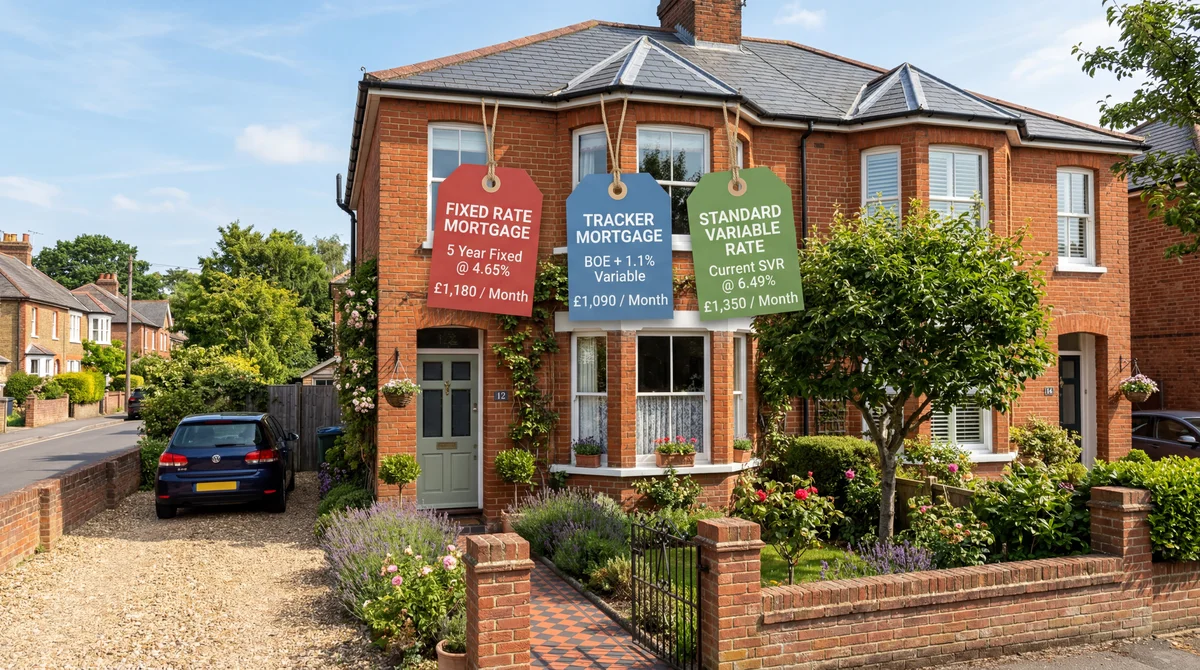
Fixed, Tracker, Variable: UK Mortgage Types Explained
A plain-English guide to UK mortgage types, terms and what to watch out for
The UK mortgage market can feel bewildering - when our broker showed us a spreadsheet of 40+ products, our eyes glazed over. But the core decision comes down to a small number of choices. Here's how we learned to think about them, and what actually mattered in the end. Rates shown are illustrative examples only and change frequently - check current figures with an FCA-authorised adviser.
Fixed rate mortgages
With a fixed rate mortgage, your interest rate is locked for an agreed period - typically 2, 3 or 5 years (sometimes 10). During the fixed period, your monthly payments don't change regardless of what happens to the Bank of England base rate or the broader economy.
We went with a 5-year fix. Our broker showed us the difference in total interest between the 2-year and 5-year options, and the certainty of knowing exactly what we'd pay each month for five years was worth the slightly higher rate. Fixed rates are the most popular choice for UK buyers, particularly in times of rate uncertainty. The trade-off is that if rates fall significantly during your fixed period, you won't benefit - and leaving early usually means an early repayment charge (ERC) which can be substantial.
- 2-year fixes: lower rate but need to remortgage sooner
- 5-year fixes: higher rate but certainty for longer - which suits a buyer depends on their circumstances
- Early repayment charges typically start at 3-5% of the outstanding balance in year 1
Tracker mortgages
A tracker mortgage has an interest rate that moves in line with the Bank of England base rate, typically at a set margin above it. So if the base rate is 4.50% and your tracker is 'base rate + 0.75%', you pay 5.25%.
Trackers are often chosen by buyers who expect rates to fall, or who are comfortable with some payment variability. Many tracker mortgages have no early repayment charge, making them more flexible.
- Check carefully whether there's a floor - some trackers won't go below a minimum rate even if the base rate falls dramatically
- Useful if you think you may overpay or want to switch deals at short notice
Standard Variable Rate (SVR) - the lender's default
The SVR is the lender's default rate, set at their own discretion and typically much higher than any deal rate. When your fixed or tracker deal ends, you revert to the SVR automatically.
Some borrowers stay on the SVR during the final months of their mortgage where the early repayment charge on remortgaging may not be worth paying. Many borrowers explore remortgage options before the deal expires - a broker can outline what's available. Home Ready is not FCA authorised - you can check any adviser on the FCA Register (register.fca.org.uk).
Repayment vs interest-only
Almost all residential mortgages for owner-occupiers are repayment mortgages - each monthly payment reduces the balance you owe, so at the end of the term the mortgage is paid off in full.
Interest-only mortgages - where you only pay the interest each month and pay off the capital at the end - are now largely restricted to buy-to-let and very high-value residential mortgages where a repayment vehicle (investment, sale proceeds) is demonstrated.
Mortgage terms: how long to borrow for
The standard mortgage term in the UK is 25 years, but 30, 35 and even 40-year terms are increasingly common as house prices have risen relative to incomes. A longer term means lower monthly payments but significantly more interest paid in total.
A mortgage broker can model the full-term interest cost on different term lengths, which shows the impact of the choice clearly.
- Illustration: on a £200,000 loan at 5%, a 30-year term costs about £95 a month less than a 25-year term - but adds roughly £36,000 in total interest
- Overpaying even small amounts early in a mortgage significantly reduces the total interest paid
Key takeaways
- 1Fixed rate mortgages offer payment certainty - which fixed term suits a buyer depends on their circumstances
- 2Tracker mortgages move with the base rate - useful if rates are expected to fall
- 3Most borrowers remortgage before reverting to the SVR, as it is typically the most expensive option
- 4Repayment mortgages are standard - you own the property outright at the end
- 5A fee-free mortgage broker can search across more lenders than going direct. Home Ready is not FCA authorised - you can check any adviser on the FCA Register (register.fca.org.uk)
General information only. This article is for educational purposes and does not constitute legal, financial, surveying or tax advice. Every property purchase is different - always consult a qualified solicitor, mortgage adviser or surveyor before making decisions. Home Ready Guide Limited is not FCA authorised.
Related articles

7 Mistakes First-Time Buyers Make (and How to Avoid Them)
Buying your first home is exciting, and it's also the point at which you're most vulnerable to making expensive mistakes. We made at least three of these ourselves - and built this guide so you don't have to. Here are the seven most common ones - and what many buyers do differently.
Read article
Stamp Duty Land Tax: A Plain-English Guide for UK Buyers
Stamp Duty Land Tax (SDLT) is one of the most misunderstood costs in buying a home. When we were buying, we had no idea how the bands worked and assumed we'd owe far more than we actually did - it caused weeks of unnecessary stress. Here's the clear breakdown we wish someone had given us.
Read article
Exchange vs Completion: What's the Difference?
We used to say 'exchange' and 'completion' interchangeably until our solicitor corrected us - they are two very different legal events that happen at different times, and confusing them can lead to costly mistakes. Understanding the difference protects you.
Read article